AI & Software Engineering
1. Microsoft Build: AI Agents Take Center Stage
Microsoft unveiled major AI advancements, emphasizing agentic AI. GitHub Copilot evolved into a full AI coding assistant, while Azure SRE Agent now autonomously executes operational tasks. The company also open-sourced Windows Subsystem for Linux and introduced NLWeb, enabling natural language interactions on the web. These innovations mark Microsoft’s deepening integration of AI into development workflows.
2. Google I/O: Gemini AI and Veo 3 Lead the Charge
Google introduced Gemini, its powerful new AI assistant replacing Google Assistant, with features like real-time voice-camera-web fusion and Gmail Smart Replies that mimic your writing style. Alongside this, Veo 3—a revolutionary AI video tool—was announced. Capable of generating 4K video with ambient audio and dialogue, Veo 3 targets pro creators and is now available in 71 countries, including via Google’s high-tier Ultra plan.
3. OpenAI Codex: AI-Powered Software Development
OpenAI debuted Codex, its advanced AI agent for developers. It automates tasks like code generation, debugging, and workflow streamlining, pushing productivity forward. Codex represents OpenAI’s ambition to redefine how developers interact with code, going beyond suggestions to handle full-stack tasks across languages and frameworks.
4. Anthropic's Claude 4 Series Released
Anthropic released Claude Opus 4 and Claude Sonnet 4, advanced AI models capable of autonomous operation for long durations. These models are optimized for high-productivity environments and showcase Anthropic's push toward safe and scalable general AI applications in business and research settings.
Cybersecurity
1. AI Drives Cybersecurity Boom
AI cybersecurity market is surging and is projected to hit $135 billion by 2030. Alphabet acquired Wiz for $32 billion, and Palo Alto Networks purchased Protect AI for $500 million. While companies enhance defenses, bad actors are also leveraging AI for scaled, sophisticated attacks, prompting global investments in advanced threat detection and prevention.
2. Microsoft: An End to Five Zero-Day Critical Exploits
The May security update resolved 78 issues, among them five zero-day vulnerabilities under active attack. These flaws affected Windows, Office, and Edge components. While details on the exploit sources remain unclear, Microsoft urges prompt patching to mitigate potential breaches, especially in enterprise environments.
3. Indian Firms Struggle with Cyber Readiness
Cisco’s Cybersecurity Readiness Index shows only 7% of Indian organizations are well-prepared for modern AI-driven threats. This gap exposes businesses to advanced ransomware and data exfiltration techniques. Experts urge Indian enterprises to adopt zero-trust architecture and enhance security training and automation.
Quantum Computing
1. Quandela Unveils Belenos Photonic Quantum Computer
France’s Quandela launched Belenos, the most powerful photonic quantum computer yet. With 4,000 times more computing capacity than its predecessor, Belenos is now available to commercial partners via the cloud. This leap underscores photonic quantum computing's promise in solving complex industrial and scientific problems.
2. Cisco's Quantum Chip and Network Expansion
Cisco announced its Quantum Network Entanglement Chip, capable of secure communication over traditional fiber networks. It also launched Cisco Quantum Labs to drive the development of distributed quantum computing. This move paves the way for quantum-secure infrastructure in logistics, pharma, and financial systems.
Programming Languages & Dev Tools
1. Rise of Rust, Swift & Mojo
Languages like Rust and Swift are gaining popularity for safety and performance, while Mojo and PureScript are drawing attention for AI and web development. These emerging languages offer modern syntax, parallelism, and advanced compiler features that streamline application scaling and efficiency.
2. No-Code Accelerates
Analysts forecast that 70% of business apps shall be developed via low-code or no-code platforms by 2025. Non-engineers are empowered by these tools; thus, the time to build an application is significantly reduced, leading to rapid innovation from across sectors particularly in the fintech and healthcare domains.
3. Google Jules: Autonomous AI Coding Assistant
Jules is Google’s AI agent that automates bug fixes, testing, and code migration. Integrated with GitHub, it operates in a secure cloud environment and uses Gemini 2.5 Pro for contextual understanding. With audio summaries and background processing, Jules boosts developer focus and productivity.
4. Android Studio Narwhal & Stitch for Devs
Google introduced Stitch, an AI tool for converting design prompts into app code. Combined with Android Studio’s Narwhal update—featuring crash diagnosis, natural-language transformations, and image-based code generation—developers can now iterate faster with fewer bugs and more polished UI experiences.
5. Kotlin 2.2 Unveiled at KotlinConf
JetBrains introduced Kotlin 2.2 with new features enhancing security and productivity. The update also brought AI-driven coding assistance and better concurrency handling, reinforcing Kotlin’s place in mobile and backend ecosystems.
Web3 & Decentralized Tech
1. CBDC Innovation Accelerates
A joint project between the New York Fed and BIS showed smart contracts could enable central banks to execute monetary policies in tokenized financial systems. This could streamline cross-border payments and reshape central banking.
2. Trump Media’s $3B Crypto Bet
Trump Media & Technology Group announced a $3 billion fundraising, including a $1 billion crypto bond initiative. The move, led by Donald Trump Jr., aligns with the former president’s push to establish the U.S. as a global crypto leader.
3. Altcoin Market Cools Down
Analysts indicate the altcoin season may be ending, with capital shifting back to Bitcoin and Ethereum. Volatility in smaller tokens has triggered a cautionary stance among investors seeking long-term stability.
Tech Events
1. IBM Think 2025
IBM’s flagship event focused on AI productivity, trusted data ecosystems, and scalable architecture. Keynotes emphasized hybrid cloud solutions and enterprise AI integrations, attracting top business and tech minds to discuss the future of intelligent enterprise systems.
2. ODSC East: Data Science Deep Dive
Open Data Science Conference gathered data scientists and AI engineers for practical workshops and keynotes on machine learning, LLMs, and MLOps.The event facilitated meaningful dialogue on ethical AI use and open-source collaboration.
3. AWS Summit Bengaluru
AWS hosted its premier Indian summit in Bengaluru, spotlighting cloud, AI, and generative tech. It featured the Innovators and Technical Editions, revealing updates to Amazon Bedrock, AI acceleration tools, and India-specific enterprise use cases—drawing thousands of tech professionals and developers.
AICOD Hackathon 2025 at IOCOD
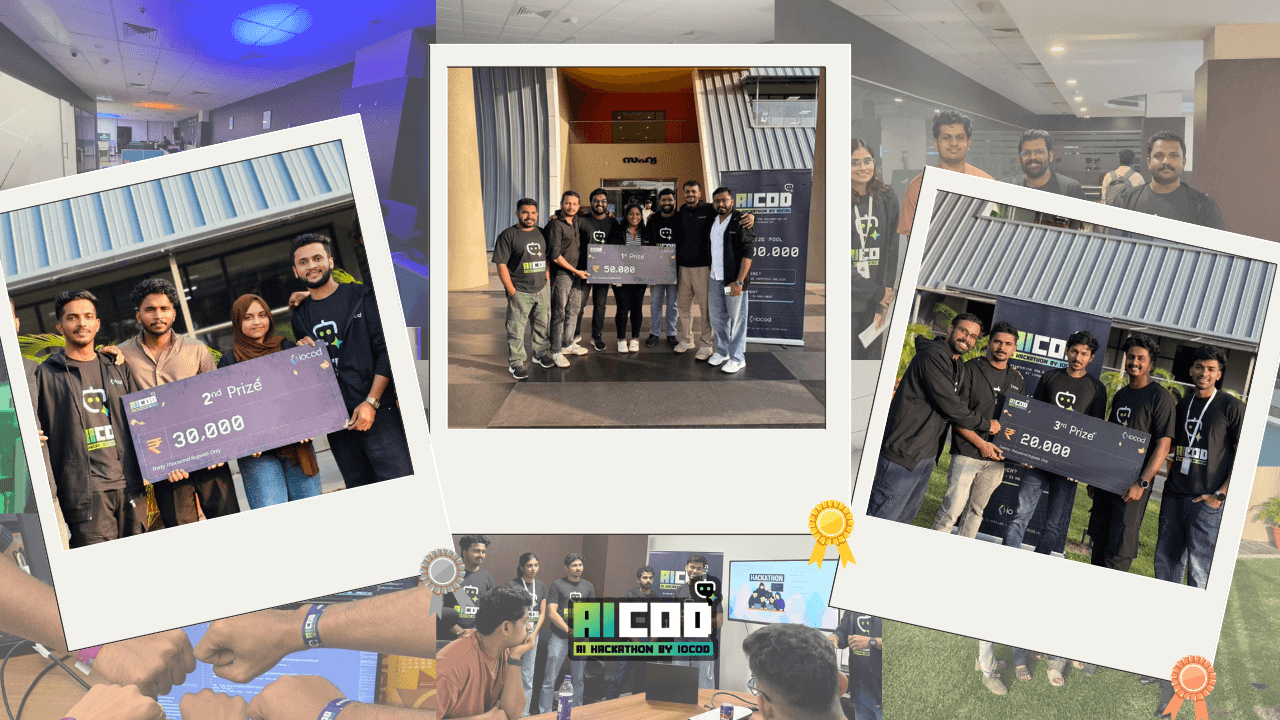
AICOD Hackathon 2025 Winners
AICOD Hackathon 2025 Winners
AICOD Hackathon 2025 Winners The AICOD Hackathon 2025 was IOCOD’s first internal AI-focused sprint—a 48-hour innovation marathon. Designed to inspire AI-driven thinking across departments, the event challenged teams to build real, working prototypes that could transform internal processes and customer experience. From automating workflows to smart coaching systems, the hackathon was all about applying machine intelligence to solve practical business problems.
The Challenge
Each team had to choose one problem from a curated list of 10 AI challenges. The problems ranged from intelligent pricing engines to real-time call coaching, each grounded in real business needs. Teams had the option to swap once if stuck but had to stick with their final choice. Groups were formed with a balance of frontend developers, backend engineers, designers, and product thinkers—ensuring each squad could go from idea to demo under pressure.
The Hackathon Experience
The hackathon kicked off with a problem reveal, followed by immediate team planning. By nightfall, teams were already knee-deep in model selection, UI mockups, and database structuring. On day two, the entire IOCOD office was buzzing—code flying across screens, and teammates snacking through stand-ups. Despite the competitive spirit, people collaborated across team lines, reviewed each other’s ideas, and even debugged APIs for rivals. It was intense, yes—but incredibly collaborative.
Learning Beyond the Code
This wasn’t just about building apps. It was a crash course in trust, creative thinking, and pushing limits. Designers experimented with AI prompt engineering. Product leads took on Git merges. Backend engineers explained ML pipelines to those who’d never touched one before. And in those shared coffee runs and 2 a.m. brainstorms, something else emerged: the sense that everyone was building something bigger than a prototype—they were building culture.
How the Teams Were Judged
Projects were evaluated across eight rigorous criteria:
- Understanding of the problem
- Innovation and creativity
- Use of AI/ML
- Functionality and completeness
- Presentation and storytelling
- Real-world applicability
- Business impact
- Code quality and technical execution
The goal wasn’t just to impress—it was to prove that a prototype could actually scale into a product that matters.
🏆 And the Winners Are...
The hackathon closed with lively demos and cheers. Beyond the prizes, it was about shared learning, teamwork, and building something meaningful together.
First Place – Squad 5 🥇
Team Lead: Akash
Problem: GUI Automation Assistant
Their AI-powered browser plugin enabled end-users to automate complex web workflows using intuitive, natural interactions. With a polished UI and backend inference engine, the tool stood out for real-time automation and potential enterprise use.
Second Place – Squad 3 🥈
Team Lead: Basil E
Problem: Regulatory Firewall
Built an AI agent that intelligently follows up with leads, timing outreach perfectly for higher deal conversions. Judges praised its strong NLP model and seamless CRM integration, calling it a future-ready sales tool.
Third Place – Squad 6 🥉
Team Lead: Shanosh Kumar
Problem: AI Call Coach
Delivered a real-time coaching engine for sales teams, analyzing live conversations and offering on-the-fly suggestions. Their innovation in sentiment scoring and agent feedback loops earned big applause.
Final Thoughts
AICOD 2025 wasn’t a typical internal event—it was a spark. It proved that given the right challenge and a ticking clock, IOCODians can build magic. Everyone brought something to the table. And when all those skills collided under one roof, innovation wasn’t a buzzword-it was a working demo. Can't wait for AICOD 2.0!